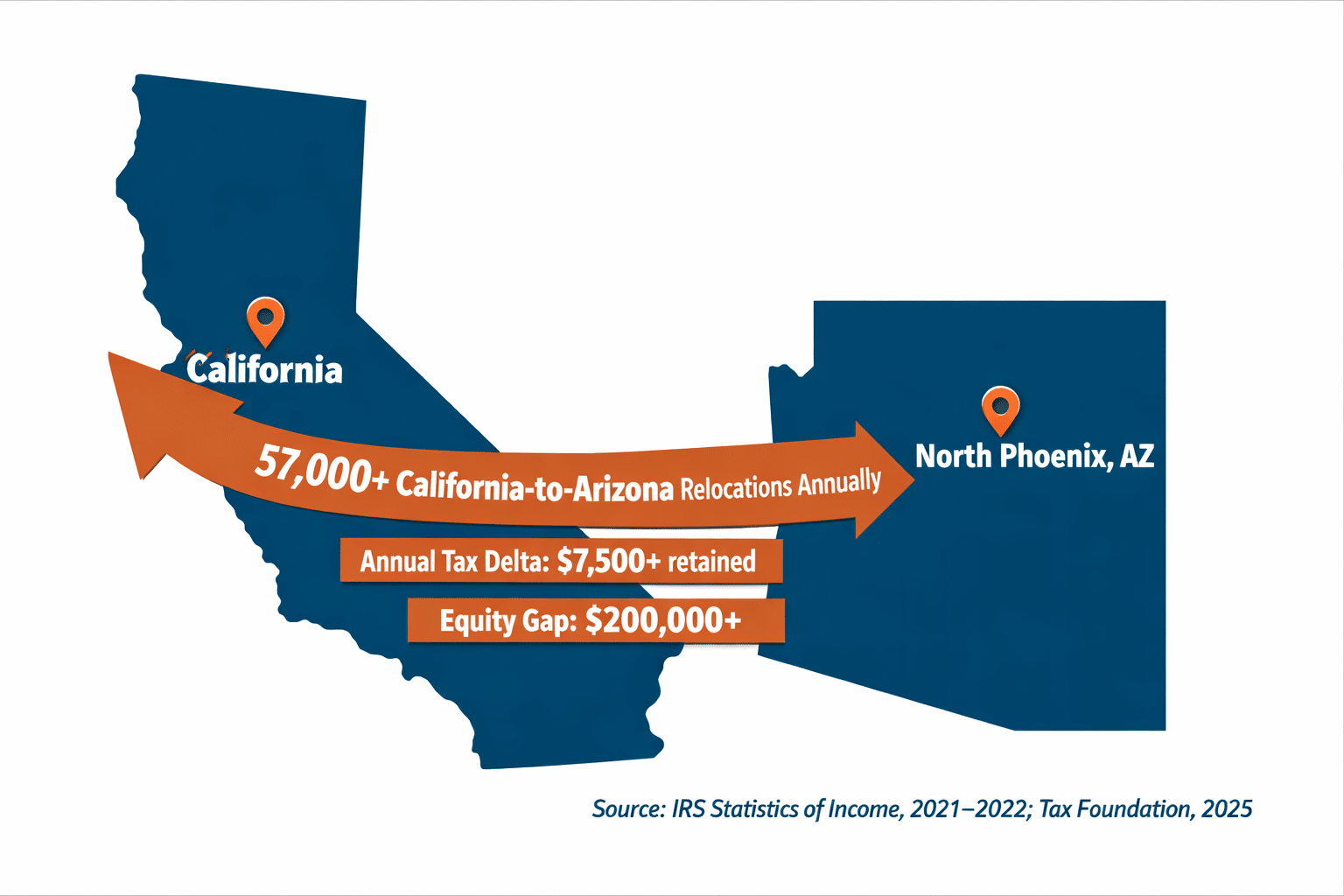
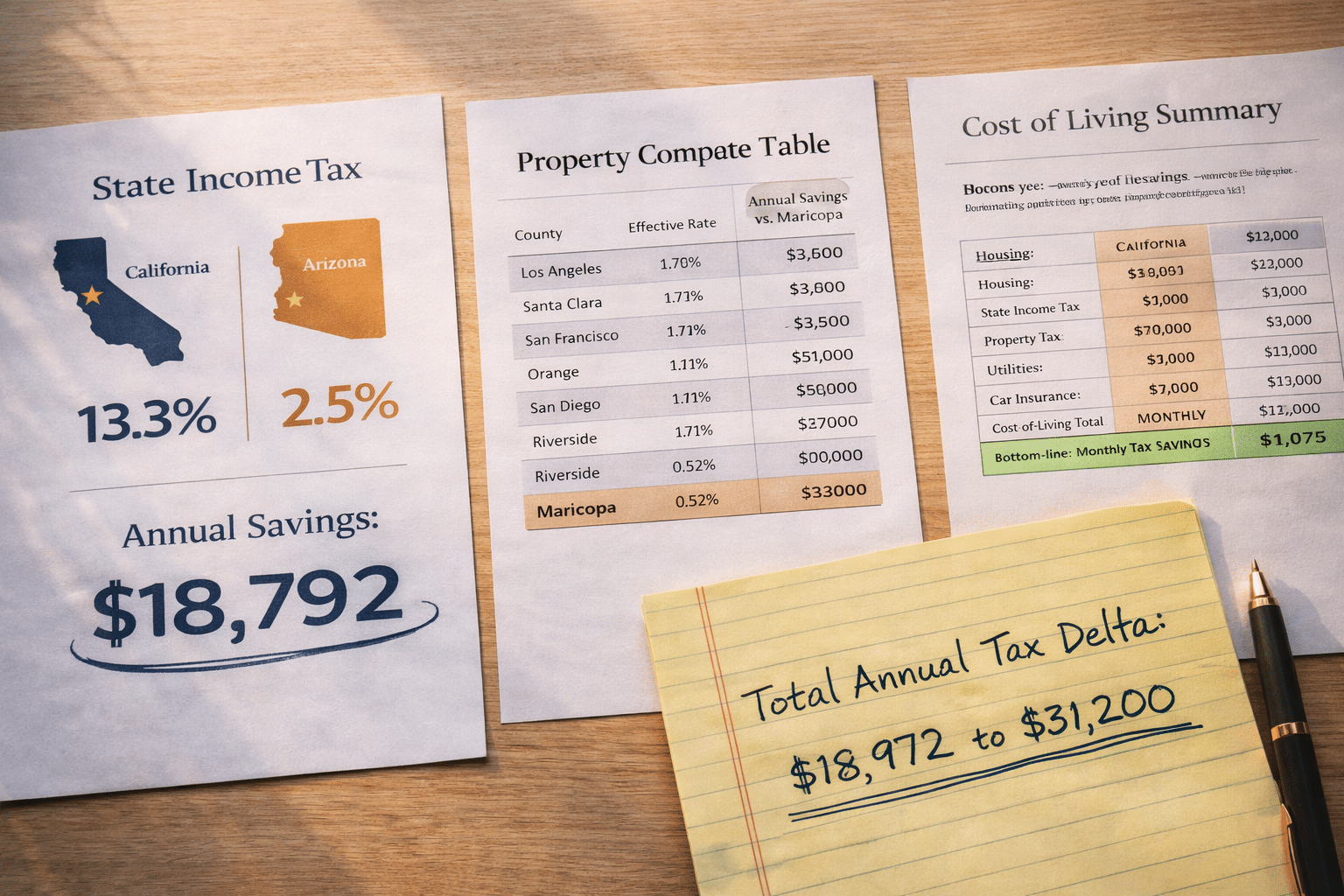
If you’re relocating in 2026, the California-to-Arizona tax differential can feel like an instant raise—especially for W-2 households. Arizona’s flat income tax and California’s progressive brackets (plus California SDI withholding) create a very real gap that can change your monthly budget and your home-buying power in the Phoenix metro.
Below is a line-by-line breakdown at three income levels using a consistent, apples-to-apples set of assumptions, along with a practical “what this means for your move” section (including how many buyers translate savings into a stronger offer in the Phoenix real estate market or a lifestyle upgrade in Scottsdale real estate options).
Important note: This is a planning illustration for the 2026 filing season (tax year 2025) using published state forms/rates. It’s not tax advice—always confirm with a CPA, especially if you have RSUs, stock options, business income, or part-year residency.
Assumptions (So the Comparison Stays Fair)
To keep this “line-by-line” and not a choose-your-own-adventure:
- Filing status: Married filing jointly (MFJ)
- Income type: W-2 wages only
- Deductions: Standard deduction only (no itemizing)
- Dependents: None (dependents change credits and outcomes)
- Other factors excluded: Local sales taxes, property taxes, mortgage interest deductions, credits, and federal taxes (since federal is the same either way)
Why these assumptions? Because they’re common for relocation households and make the difference easy to see.
The California-to-Arizona Tax Differential: What We’re Comparing Line-by-Line
Here are the “moving parts” we’re using:
California (2025 tax year / 2026 filing season)
- California standard deduction (MFJ): $11,412
- California income tax rate schedule (MFJ): Progressive brackets (Schedule Y)
- California personal exemption credit: $153 per taxpayer (so $306 for MFJ)
- California SDI withholding: 1.3% of wages in 2026, with all wages subject
Why include SDI? Because it’s a real paycheck withholding cost many relocating households want to see in the same “state tax” picture. (It also funds benefits—so think of it like a required payroll contribution, not “income tax.”)
Arizona (2026 planning using current published guidance)
- Arizona income tax rate: 2.5% flat tax rate (tax year 2023 and beyond)
- Arizona standard deduction (MFJ): $31,500
Line-by-Line Breakdown at Three Income Levels
Below, each scenario shows the same steps:
- Start with gross household income
- Subtract the state standard deduction
- Compute state income tax
- Apply California’s personal exemption credit (CA only)
- Add California SDI withholding (CA only)
- Compare totals
Scenario 1: $120,000 Household Income (MFJ)
California
- Gross income: $120,000
- Minus CA standard deduction: $11,412
- CA taxable income: $108,588
- CA income tax (Schedule Y, then minus $306 exemption credit): ≈ $3,279
- CA SDI withholding (1.3%): ≈ $1,560
- Estimated CA total (income tax + SDI): ≈ $4,839
Arizona
- Gross income: $120,000
- Minus AZ standard deduction: $31,500
- AZ taxable income: $88,500
- AZ income tax (2.5% flat): ≈ $2,213
- Estimated AZ total: ≈ $2,213
Estimated annual difference (CA – AZ): ≈ $2,627
That’s about $219/month.
Scenario 2: $250,000 Household Income (MFJ)
California
- Gross income: $250,000
- Minus CA standard deduction: $11,412
- CA taxable income: $238,588
- CA income tax (Schedule Y, then minus $306 exemption credit): ≈ $14,760
- CA SDI withholding (1.3%): ≈ $3,250
- Estimated CA total (income tax + SDI): ≈ $18,010
Arizona
- Gross income: $250,000
- Minus AZ standard deduction: $31,500
- AZ taxable income: $218,500
- AZ income tax (2.5% flat): ≈ $5,463
- Estimated AZ total: ≈ $5,463
Estimated annual difference (CA – AZ): ≈ $12,547
That’s about $1,046/month.
Scenario 3: $500,000 Household Income (MFJ)
California
- Gross income: $500,000
- Minus CA standard deduction: $11,412
- CA taxable income: $488,588
- CA income tax (Schedule Y, then minus $306 exemption credit): ≈ $38,010
- CA SDI withholding (1.3%): ≈ $6,500
- Estimated CA total (income tax + SDI): ≈ $44,510
Arizona
- Gross income: $500,000
- Minus AZ standard deduction: $31,500
- AZ taxable income: $468,500
- AZ income tax (2.5% flat): ≈ $11,713
- Estimated AZ total: ≈ $11,713
Estimated annual difference (CA – AZ): ≈ $32,797
That’s about $2,733/month.
Quick Summary Table
| Household Income (MFJ) | Est. CA Income Tax | Est. CA SDI | Est. CA Total | Est. AZ Total | Est. Annual Difference |
|---|---|---|---|---|---|
| $120,000 | $3,279 | $1,560 | $4,839 | $2,213 | $2,627 |
| $250,000 | $14,760 | $3,250 | $18,010 | $5,463 | $12,547 |
| $500,000 | $38,010 | $6,500 | $44,510 | $11,713 | $32,797 |
Rounded estimates. Real returns vary based on credits, dependents, itemizing, and CA/AZ-specific additions/subtractions.
What This Means for Your Phoenix Metro Move (Practical, Not Theoretical)
For many relocating households, the California-to-Arizona tax differential shows up in one of three ways:
1) More comfortable monthly housing payment
At the $250K household income level in our example, about $1,046/month is the kind of number buyers often redirect toward:
- A better location
- A single-story layout
- A pool-ready yard
- A rate buydown (when it makes sense)
That’s why you’ll see California relocators comparing family-friendly East Valley areas like Gilbert homes and neighborhoods with growth-oriented options like Queen Creek new-home communities.
2) A bigger down payment (or keeping more cash liquid)
If you’re planning to buy soon after arrival, those annual savings can build a stronger down payment—without changing your lifestyle.
When you’re ready to sanity-check what your budget buys in real time, start by browsing Arizona homes for sale across the Valley.
3) “Residency strategy” becomes part of your timeline
California residency rules can be strict, and part-year moves can create edge cases (especially with bonuses, RSUs, or a business). If your income is complex, don’t guess—bring a tax pro into your relocation plan early.
Taxes We Didn’t Include (But You Should Still Think About)
Even though the line-by-line breakdown above is focused on state income tax + CA SDI, your real-world “tax feel” also depends on:
- Property taxes: California’s Prop 13 can mean long-time owners have unusually low property taxes compared to a new purchase elsewhere (including Arizona).
- Sales tax: Varies widely by city and county in both states.
- Vehicle registration & fees: Can differ more than people expect.
- High-income add-ons: California has an additional 1% tax over $1,000,000 of taxable income (not relevant in the three scenarios above, but important for some households).
Image Suggestions for This Post
- A simple infographic: “CA vs AZ: State income tax + SDI at $120K / $250K / $500K”
- Phoenix skyline + caption: “Relocating in 2026? Here’s what your paycheck may do differently in Arizona.”
- Map graphic showing Phoenix-area commute rings (East Valley vs West Valley)
FAQs
Does Arizona really have a flat income tax?
Yes—Arizona uses a 2.5% flat tax rate for Arizona taxable income (tax year 2023 and beyond).
Why did you include California SDI in the comparison?
Because it’s a required payroll withholding (1.3% in 2026, with all wages subject) that changes many households’ take-home pay when they move.
Will my numbers be different if I itemize or have kids?
Very likely. Itemized deductions, dependents, credits, stock compensation, and part-year residency can materially change the outcome.
If I move mid-year, do I pay both states?
Possibly. Many households file part-year returns, and CA-source income may still be taxable by California even after a move depending on timing and income type. Talk with a CPA.
How do people use the savings when buying in Arizona?
Most commonly: increased monthly comfort, a stronger down payment, or keeping more cash liquid for renovations/furnishings.
Bottom Line
For many relocating households, the California-to-Arizona tax differential in the 2026 filing season isn’t just a headline—it can be hundreds to thousands per month depending on income, because you’re comparing California’s progressive income tax structure (plus SDI withholding) to Arizona’s flat rate approach.
If you want to translate that “paper savings” into a smart home search (without getting overwhelmed by neighborhoods), start with West USA Realty and explore current Arizona homes for sale. For a step-by-step relocation-friendly roadmap, the Arizona home buying resources hub is a great next click.