
Oregon’s top income tax rate is 9.9%. Arizona’s is 2.5% flat. For a Portland-area household earning $250,000, that single rate differential can translate to more than $15,000 in annual state income tax savings — before factoring in local Metro and Multnomah County taxes. This guide runs every number.
Oregon taxes income on a graduated scale with four brackets, ranging from 4.75% to 9.9% for tax year 2025. That top 9.9% rate applies to taxable income above $125,000 for single filers and above $250,000 for married filing jointly. Source: Oregon Department of Revenue, 2025 Tax Rate Charts.
For context: only two states — California (13.3%) and Hawaii (11%) — levy a higher top marginal individual income tax rate than Oregon. Arizona, by contrast, replaced its graduated bracket structure with a single flat rate of 2.5% beginning in tax year 2023. Every dollar of Oregon taxable income above the top threshold costs $0.099 in state tax. The same dollar earned in Arizona costs $0.025.
Oregon’s four income tax brackets (Tax Year 2025 — Single Filer): • 4.75% on the first $4,300 of taxable income • 6.75% on taxable income from $4,301 to $10,750 • 8.75% on taxable income from $10,751 to $125,000 • 9.9% on taxable income above $125,000
Married filing jointly thresholds are double the single filer amounts. Source: Oregon Department of Revenue, 2025 Rate Charts.
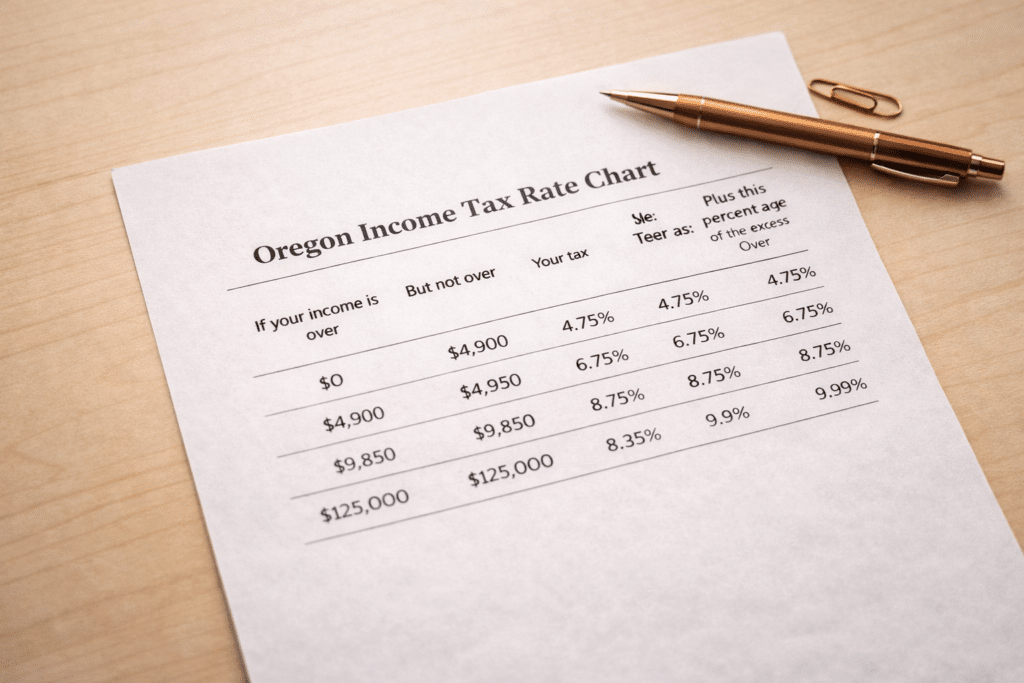
Source: Oregon DOR & Arizona DOR, Tax Year 2025
Oregon’s state income tax is only part of the tax equation for Portland Metro homeowners. The region has added two voter-approved local income taxes that apply to high-income earners — taxes that do not exist anywhere in Arizona.
METRO SUPPORTIVE HOUSING SERVICES (SHS) TAX: A 1% personal income tax applies to Metro taxable income above $125,000 for single filers and above $200,000 for joint filers. The Metro district encompasses Clackamas, Multnomah, and Washington counties — covering the majority of the greater Portland housing market. This tax applies whether you live in Metro or work there. Source: City of Portland Revenue Division; Metro, Tax Year 2025.
MULTNOMAH COUNTY PRESCHOOL FOR ALL (PFA) TAX: Multnomah County residents or earners face an additional layer. The PFA tax applies to income above $125,000 (single) and $200,000 (joint) at the following rates: 1.5% on income above those thresholds, and an additional 1.5% on income above $250,000 (single) or $400,000 (joint). Source: City of Portland Revenue Division, Multnomah County PFA Tax, Tax Year 2025.
ARIZONA LOCAL INCOME TAXES: NONE. Arizona state law does not permit local income taxes. Every Arizona resident pays the same 2.5% flat rate — no city, no county, no regional surtax on top. Source: Arizona Department of Revenue, Tax Year 2025.

| Tax Layer | Portland (Mult. Co) |
Phoenix (AZ) |
|---|---|---|
| State Income Tax | $21,273 | $6,250 |
| Metro SHS Local Income Tax (1% > $200K joint) | $500 | $0 |
| Multnomah PFA Tax (1.5% > $200K joint) | $750 | $0 |
| TOTAL INCOME TAX BURDEN | $22,523 | $6,250 |
| ANNUAL INCOME TAX SAVINGS IN ARIZONA | $16,273 |
Sources: Oregon DOR Rate Charts (2025); Arizona DOR (2025); City of Portland Revenue Division — SHS and PFA Tax Programs (2025). Estimates based on gross taxable income of $250,000 MFJ, prior to individual credits and deductions. Consult a licensed tax professional before making relocation decisions.
Note: The Metro SHS tax is currently authorized through tax year 2025, with future-year thresholds subject to inflation adjustment beginning in 2026. Source: Metro, oregonmetro.gov.
Oregon’s effective property tax rate on owner-occupied housing is 0.78%, according to the Tax Foundation. That figure places Oregon above the national median but below high-rate states like New Jersey (2.23%) and Illinois (2.08%).
Maricopa County, the core county of the Phoenix Valley, has cut its primary property tax rate four consecutive years through fiscal year 2024–2025. The effective property tax rate for owner-occupied housing in Arizona is approximately 0.52% — meaningfully lower than Oregon’s rate.
An important structural note: Oregon’s property tax system caps annual assessed value growth at 3% per year under Measure 50 (1997). This creates a gap between assessed value and real market value that tends to narrow when homeowners sell and a property is reassessed. For Oregon homeowners who have held property for many years, their tax bill likely understates what a new owner would pay — and that realized rate at point of sale can be substantially higher than the effective rate shown above.
In Arizona, assessed values are subject to state valuation rules, and Maricopa County has reduced its primary levy rate each of the past four years. Source: Maricopa County Board of Supervisors, May 2024.
Oregon has no state sales tax — a meaningful consumer benefit for residents buying vehicles, appliances, furniture, and other durable goods. Arizona’s combined state and local average sales tax rate is approximately 8.37% (Tax Foundation, 2024). For a household spending $60,000 annually on taxable goods and services, that differential represents roughly $5,000 per year in additional consumption costs in Arizona.
This is a real offset that financially literate homeowners should factor into their relocation math — but it is rarely a full counterweight to the income and estate tax savings available in Arizona. The calculation depends heavily on household spending patterns.
For homeowners, sales tax also applies to construction materials, major appliances, and home improvement purchases — costs that accrue significantly during the first years after a move. Buyers of newly constructed Arizona homes should account for this in their initial-year budget modeling.


Oregon levies a state estate tax on estates valued above $1 million. The marginal rate structure runs from 10% to 16% on the taxable portion of the estate above that threshold. Oregon’s $1 million exemption is not indexed for inflation — meaning it does not automatically adjust upward as home values rise. An Oregon homeowner sitting on $800,000 in equity, combined with retirement assets and life insurance, may cross that threshold.
Arizona has no state estate tax and no state inheritance tax. Source: Tax Foundation, State Estate and Inheritance Tax Rates, 2024.
For a Portland-area homeowner whose estate is projected to exceed $1 million at death, the estate tax differential is a multi-generational wealth preservation consideration — not just a personal income tax calculation.

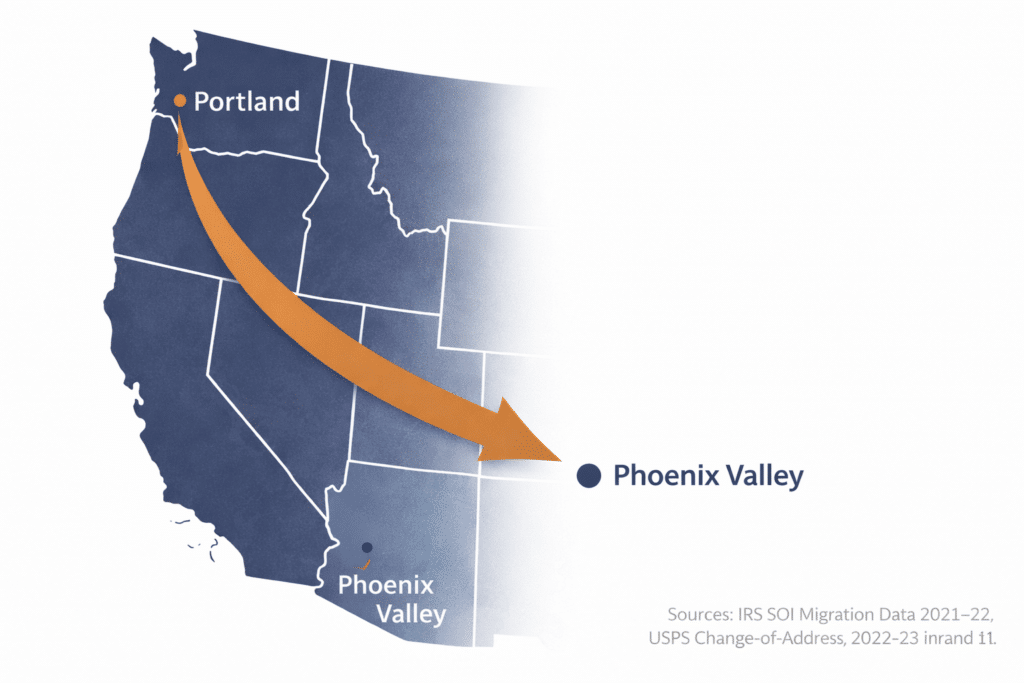
IRS Statistics of Income migration data confirms sustained net outflows of tax filers from Oregon to Arizona, with outbound filers consistently reporting higher average adjusted gross income than inbound filers — a pattern consistent with equity-holding homeowners making financially motivated relocation decisions. Source: IRS Statistics of Income, State-to-State Migration Data, 2021–2022 (most recent available release).
USPS Change-of-Address data similarly shows sustained net address forwarding from the Portland metropolitan area to Phoenix Valley ZIP codes across Maricopa County. Source: USPS Change-of-Address Data, 2022–2023.
For homeowners weighing this move, the aggregate data reflects the same financial logic this page documents at the individual level: Oregon’s combined tax burden — state income, local income, and estate tax exposure — creates a sustained capital outflow incentive for high-equity households.
Our brokerage partner, West USA Realty, represents buyers relocating to Gilbert, Chandler, Scottsdale, and all Phoenix Valley communities. Connect directly with a licensed Arizona agent at westusa.net.


GILBERT Median Home Price: ~$530,000–$595,000 (2024 ARMLS data range) New Construction Share: Among the highest of any East Valley community
Property Tax (Maricopa County): Effective rate approximately 0.52%

CHANDLER Median Home Price: ~$525,000–$575,000 (2024 ARMLS data range) Proximity: Loop 101 / I-10 employment corridors
Property Tax (Maricopa County): Effective rate approximately 0.52%

SCOTTSDALE Median Home Price: ~$900,000+ (luxury corridor) to ~$650,000 (South Scottsdale)
Property Tax (Maricopa County): Effective rate approximately 0.52% Effective Property Tax Rate vs. Portland metro: materially lower
Median price ranges are approximate. Verify current figures against ARMLS monthly market reports before making any purchase decision.
| Tax Category | Oregon | Arizona | Advantage |
|---|---|---|---|
| Top Marginal Income Tax Rate | 9.9% | 2.5% (flat) | Arizona |
| Income Tax Structure | 4 graduated brackets | Single flat rate | Arizona |
| Local Income Tax (Portland Metro) |
Up to 4% combined (SHS 1% + PFA 1.5–3%) |
None | Arizona |
| Effective Property Tax Rate | 0.78% | ~0.52% | Arizona |
| State Sales Tax | 0% | ~8.37% avg. | Oregon |
| Estate Tax | 10%–16% above $1M | None | Arizona |
| Inheritance Tax | None | None | Neutral |
| Capital Gains Tax Rate | Same as income (9.9% at top bracket) | Same as income (2.5%) | Arizona |
Sources: Oregon Department of Revenue (2025); Arizona Department of Revenue (2025); Tax Foundation, State Tax Competitiveness Index (2024); City of Portland Revenue Division, SHS and PFA Tax Programs (2025); Maricopa County Board of Supervisors, FY 2024–25 Budget.
This table is for general educational comparison purposes only and does not constitute tax advice. Consult a licensed CPA or tax attorney before making relocation decisions based on this information