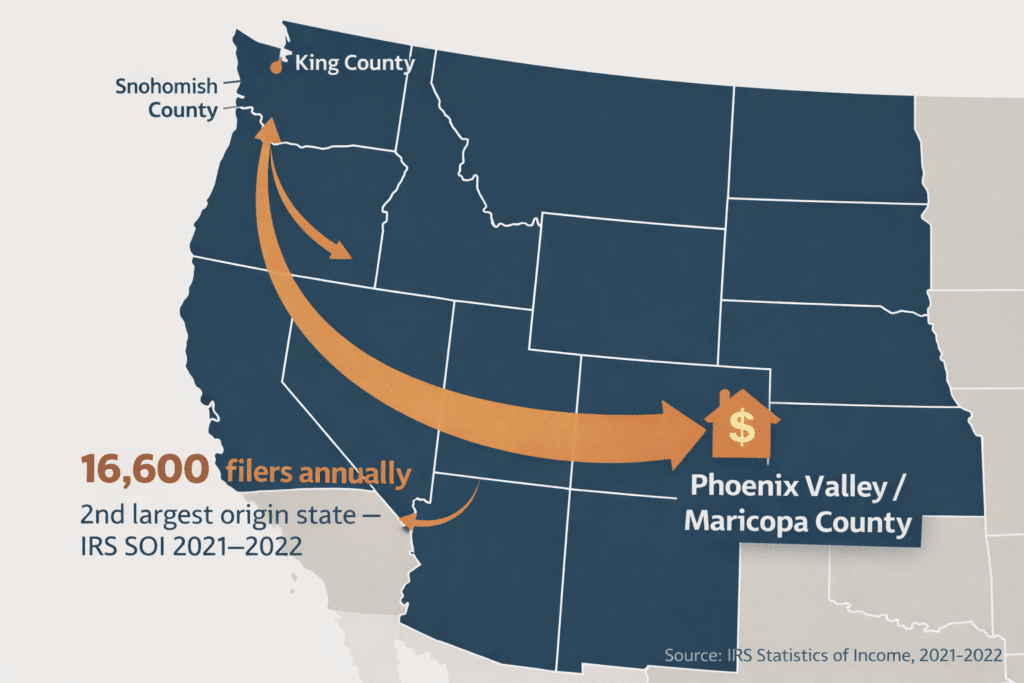
King County’s median home price reached $887,300 in October 2025. The Greater Phoenix median is $450,000. That ~$437,000 spread is not a headline statistic it is deployable capital once the sale closes. In the 2021–2022 IRS filing year, 16,600 Washington state tax filers moved to Arizona, making Washington the second-largest origin state for Arizona-bound domestic migration.
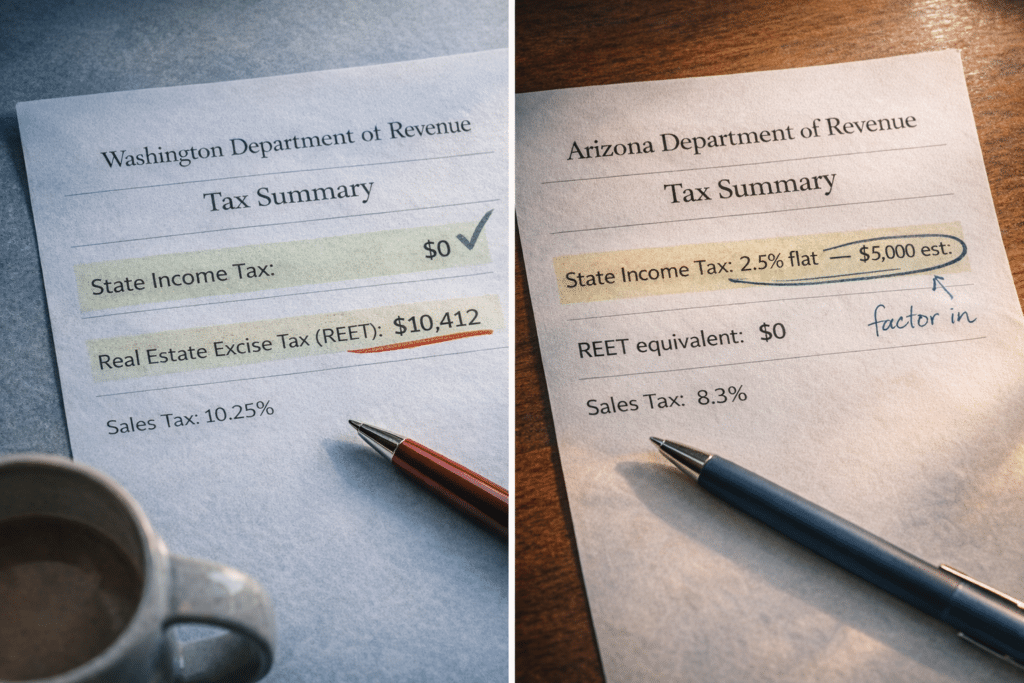
The financial arithmetic for Seattle homeowners is different from California’s — and it requires more careful unpacking. Washington state has no income tax. Arizona charges a flat 2.5% on all income. For a household earning $200,000, that means moving to Arizona adds approximately $5,000 per year in state income tax liability that did not exist in Washington. That figure belongs in your calculation, and this guide will not obscure it.
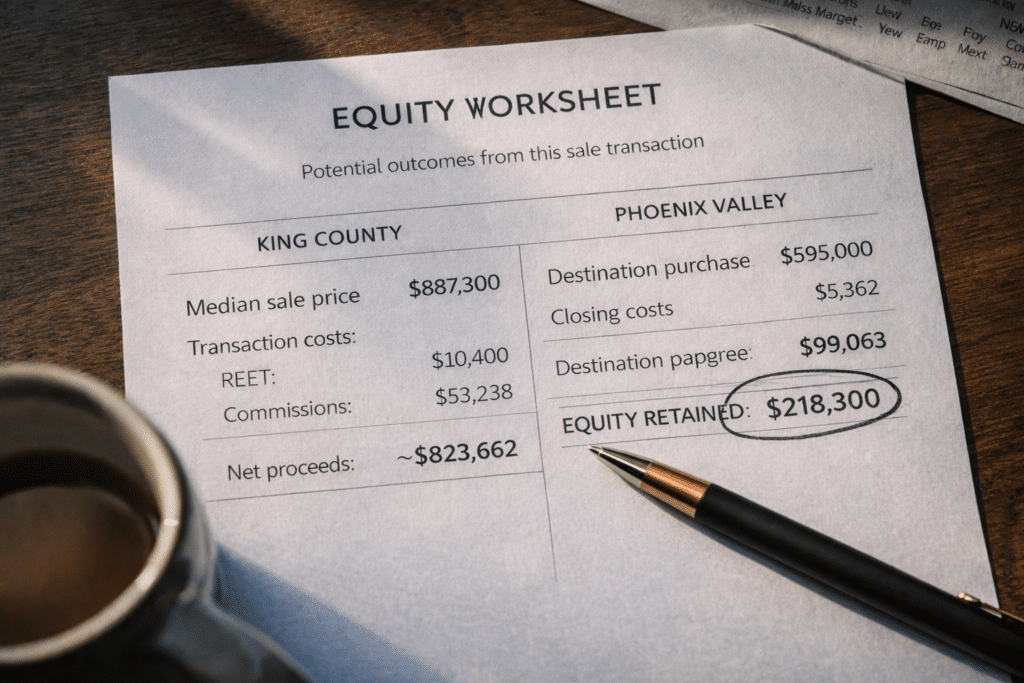
King County homeowners who sell at the October 2025 NWMLS median of $887,300 and purchase a comparable or larger home in the Greater Phoenix area at the ARMLS median of $450,000 free up a pre-transaction-cost equity spread of roughly $437,000. After standard transaction costs — including Washington’s Real Estate Excise Tax on the sale, agent commissions, and Phoenix closing costs — most King County sellers at or near the median retain somewhere between $340,000 and $400,000 in net equity upon purchase.
Sources: Northwest Multiple Listing Service (NWMLS), October 2025; Arizona Regional Multiple Listing Service (ARMLS), November 2025
That equity delta is the primary lever. A household that retains $370,000 in net cash after purchasing a Phoenix-area home debt-free or with a substantially reduced mortgage has fundamentally restructured its balance sheet. The annual income tax delta of $5,000 — real, and worth factoring — is paid back in full by that retained equity within the first year of a conservative 4% annual return on invested capital. Over a decade, the equity redeployment compounds; the income tax differential does not.
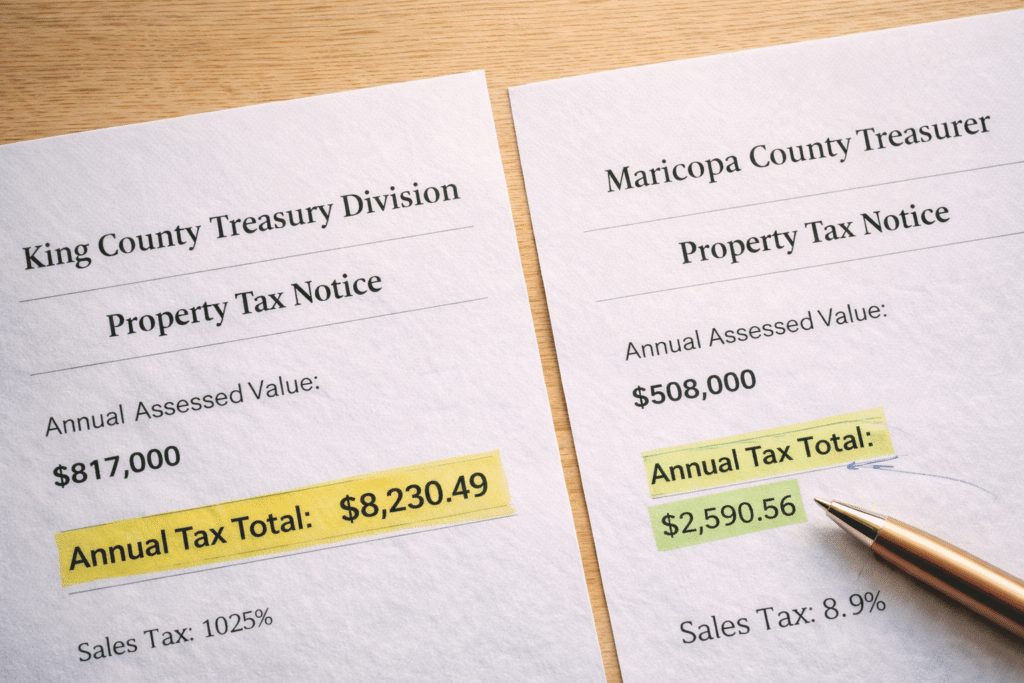
The secondary levers matter as well. King County’s effective property tax rate runs approximately 0.92%, according to Washington State Department of Revenue data. Maricopa County’s effective rate is approximately 0.52%, per the Maricopa County Treasurer. On a $500,000 assessed value, that difference produces an annual property tax savings of roughly $2,000. Washington’s combined sales tax rate in the Seattle-King County area runs approximately 10.5%. Arizona’s statewide average combined sales tax is 8.4%, per the Tax Foundation — a 2.1- percentage-point reduction applied to every taxable purchase.
The complete financial picture for Seattle-area homeowners is more nuanced than the California migration story. But for high-equity King County sellers, the equity arbitrage is large enough that the math still closes — decisively — in Arizona’s favor for many households.
Relocating from a no-income-tax state to Arizona requires a full accounting of every tax variable. The table below presents the complete picture for a King County household — including the one category where Arizona costs more.
The income tax row is the most important one to read clearly. Washington charges no state income tax. Arizona charges 2.5% flat. For a dual-income household earning $250,000 combined, the move to Arizona costs approximately $6,250 per year more in state income taxes than staying in Washington. That number is real, and any financial analysis that omits it is doing you a disservice.
But the property tax math moves the other direction. A King County homeowner currently paying annual property taxes on an $887,300 assessed value at 0.92% is paying approximately $8,163 per year. A Maricopa County homeowner on a $500,000 Arizona purchase at 0.52% pays approximately $2,600 per year — a reduction of $5,563 annually. The property tax savings more than offset the income tax increase for many households, and the sales tax reduction compounds the advantage further.
| Tax Category | Washington (King Co.) | Arizona (Maricopa Co.) |
|---|---|---|
| State Income Tax | 0% (no state income tax) | 2.5% flat rate |
| Effective Property Tax Rate | ~0.92% | ~0.52% |
| Avg Combined Sales Tax | ~10.5% (Seattle area) | ~8.4% |
| Real Estate Excise Tax (seller) | Yes — tiered; ~1.1%–1.28% on median-price sale | No equivalent seller excise tax |
| Estate Tax | Yes — applies above $2.193M; 10%–20% | None |
| Capital Gains Tax (investment assets) | 7% on gains above $278K; 9.9% above $1M (real estate exempt) | None (no state-level investment CG tax) |
Sources: Tax Foundation 2025; Washington Dept. of Revenue; Maricopa County Treasurer.
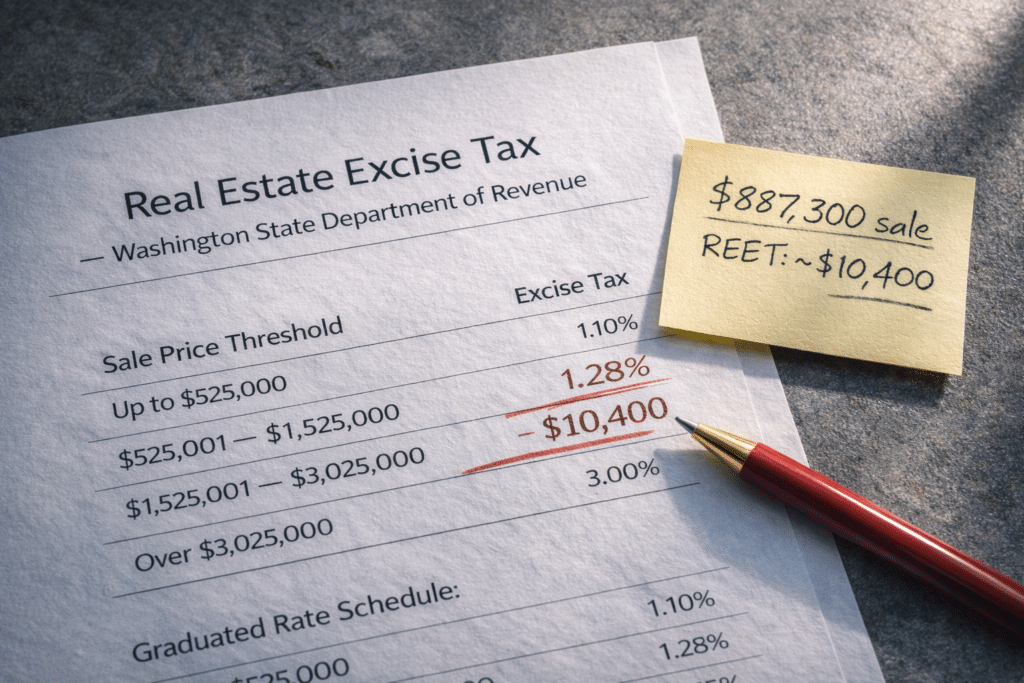
Washington’s Real Estate Excise Tax — a seller-paid tax on real property transactions — adds a significant transaction cost that Arizona does not impose at the state level. On a $887,300 King County home sale, the graduated REET produces a tax liability of approximately $10,000 to $11,000, depending on the specific taxing district. This is a one-time exit cost embedded in the Washington homeownership equation that Arizona buyers never face.
For investment asset holders — those with substantial stock or bond portfolios outside of retirement accounts — Washington’s capital gains tax (7% on gains above the annual standard deduction, 9.9% on gains above $1 million, effective 2025) creates an additional layer of divergence from Arizona, which has no equivalent tax on investment asset sales. Real estate sales are exempt from Washington’s capital gains tax.
The Bureau of Labor Statistics Consumer Price Index for the Seattle-Tacoma- Bellevue metropolitan area has consistently tracked 10% to 15% above the national average. The Phoenix metro, by contrast, runs approximately 3% to 6% above the national average, depending on the specific municipality and category. The gap between the two metros on an aggregate cost-of-living basis is substantial and extends well beyond housing.
Housing is still the dominant variable. A King County homeowner currently carrying a $4,100 per month mortgage on a median-priced property (approximate payment on an $887,300 purchase with 20% down at 6.5%) could carry a comparable or larger home in Gilbert or Chandler at roughly $2,600 to $3,100 per month — a reduction of $1,000 to $1,500 in monthly housing costs. Over ten years, that reallocation produces between $120,000 and $180,000 in additional savings or investable capital, before accounting for the equity retained from the sale differential.
Estimated monthly mortgage payment reduction for a King County seller purchasing at the Gilbert or Chandler median (6.5% rate, 20% down on both)
Source: Calculation based on NWMLS and ARMLS median price data, standard mortgage assumptions
Washington’s combined state-and-local sales tax rate in the Seattle-King County corridor runs approximately 10.5%, among the highest in the nation. Arizona’s average combined sales tax is 8.4%, per Tax Foundation 2025 data. For a household spending $60,000 annually on taxable goods and services, a 2.1- percentage-point reduction in sales tax produces approximately $1,260 per year in additional after-tax purchasing power — consistent, compounding, and often overlooked in relocation math.
Seattle’s auto insurance market has also ranked among the most expensive in the Pacific Northwest, driven by high vehicle density, litigation costs, and repair cost indexes. Phoenix-area auto insurance premiums trend meaningfully lower for comparable coverage. Property insurance on single-family homes in the Phoenix Valley is available at competitive rates, though homeowners should budget for appropriate coverage on pool equipment and HVAC systems that run heavily during summer months.
Summer cooling costs deserve their own line item: Phoenix Valley electric bills typically run $250 to $400 per month from June through September in a typical single-family home. This is the one category where Seattle costs substantially less. Model it in — but also model in that you’re exiting a housing market that added approximately 3.2% per year to your property tax bill in assessed value growth, and entering a Maricopa County system with a meaningfully lower effective rate on your new, lower purchase price.
A King County seller at the $887,300 median carries estimated net proceeds of approximately $790,000 to $820,000 after Washington’s REET, agent commissions, and standard closing costs. The table below maps those proceeds against the six primary destination communities for Seattle-origin buyers.
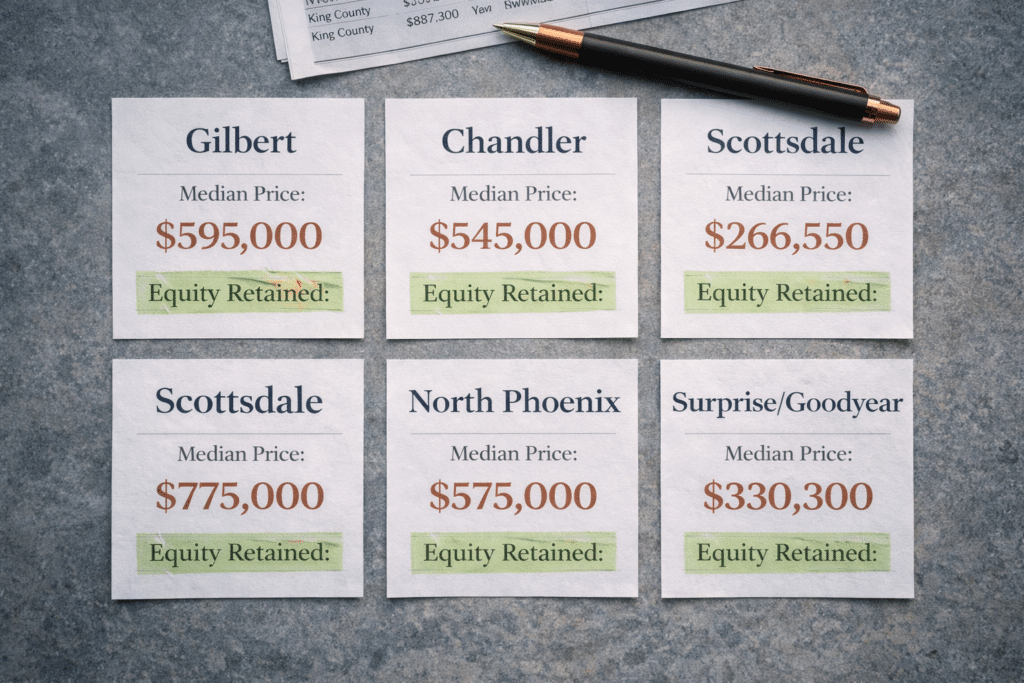

Est. Equity Retained: ~$195K–$225K
Master-planned communities; HOA amenities

Est. Equity Retained: ~$250K–$280K
Price Road / tech-corridor proximity

Est. Equity Retained: Premium positioning
Highest-priced destination tier
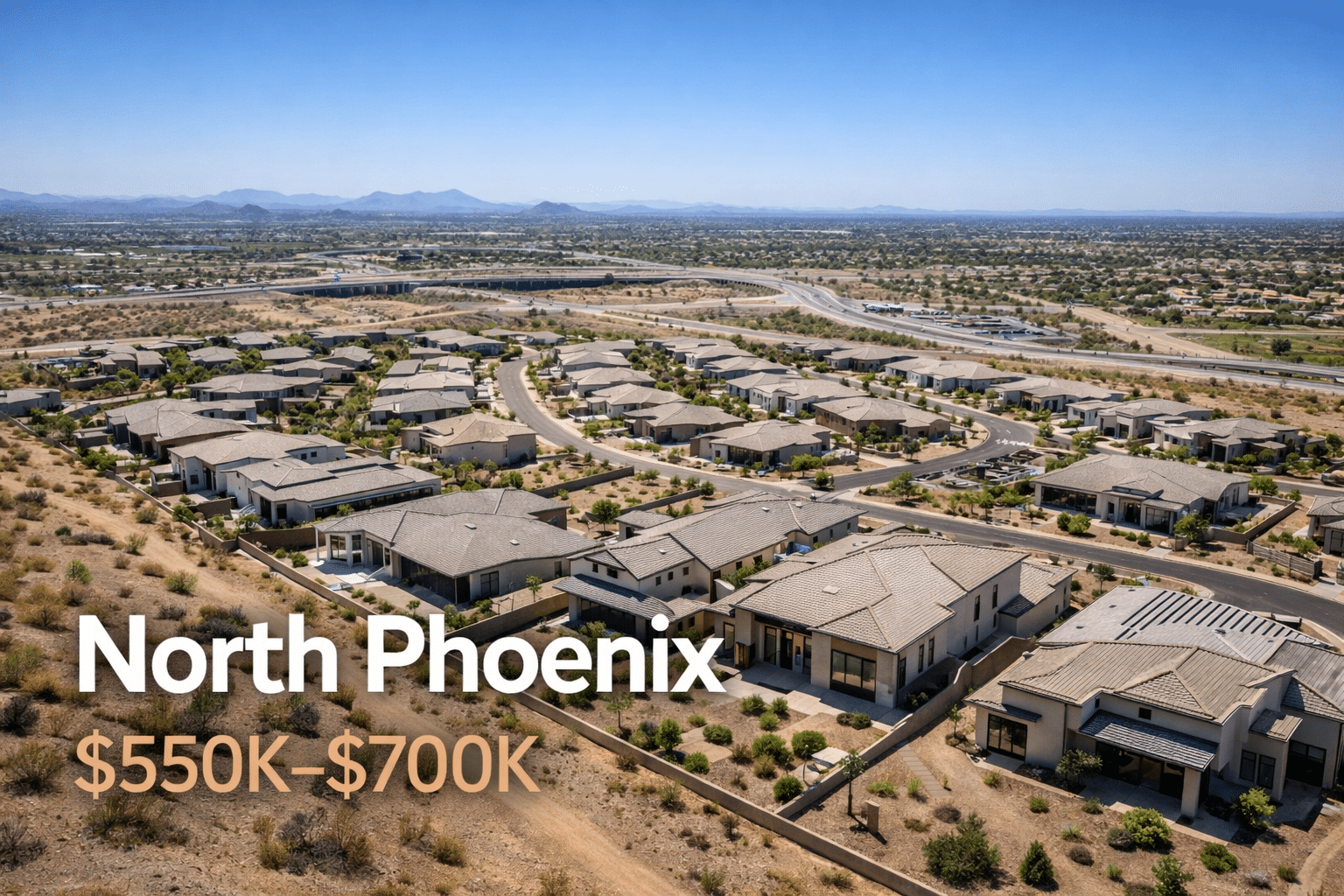
Est. Equity Retained: ~$90K–$270K
Newer builds; Loop 101/51 access

Est. Equity Retained: ~$360K–$390K
Maximum retained equity; newer inventory mix
Price data: ARMLS, Phoenix REALTORS year-to-date 2025 reports. Net equity estimates assume Washington REET (~1.1–1.28% on the sale), 6% combined agent commissions, and standard Phoenix closing costs.
The Seattle migration story is not uniform. A homeowner in Bellevue faces a different equity equation than one in South King County. Each origin submarket carries its own price point, REET exposure, and retained equity potential.
Seattle Core The Seattle proper median runs modestly below the county-wide figure in certain neighborhoods, but tech-corridor proximity has kept prices in Capitol Hill, Queen Anne, and Fremont well above $800,000 for standard single-family inventory. Sellers in these corridors represent some of the most favorable equity positions for Arizona destination math.
Eastside Bellevue, Kirkland, Mercer Island, and Redmond consistently post medians above $1.2M for single-family homes, driven by proximity to major technology employers on the Eastside. Equity positions in this submarket are among the largest available in the Pacific Northwest for residential sellers.
(Everett / Edmonds) Snohomish County posted a median of approximately $739,500 in October 2025, per NWMLS data, down slightly year-over-year. Sellers in this submarket retain a meaningful equity position for most Phoenix Valley destinations.
Washington’s migration to Arizona is the second-largest state-origin flow in the nation, behind only California. According to IRS Statistics of Income data for the 2021–2022 filing year, 16,600 Washington state tax filers relocated to Arizona — representing more than double the volume of the third-ranked origin state. This is not a trickle of retirees. The IRS data consistently shows that the $100,000 to $200,000 income bracket is among the fastest-growing migration cohorts, which is the financial profile of an equity homeowner making a calculated balance-sheet decision.
Washington state posted what the Tax Foundation characterized as a net gain in tax returns from interstate migration in the 2021–2022 data — but a net loss in adjusted gross income associated with those returns. Stated plainly: Washington was gaining new residents at lower average income levels while losing residents at higher average income levels. The outbound cohort going to Arizona trends toward higher-income, higher-equity households. These are not households being pushed out by financial hardship; they are households optimizing a significant asset position.
Arizona’s overall domestic migration position continues to strengthen. According to Census Bureau population estimates released in December 2024, Arizona gained 109,357 total residents in the 2023–2024 period, ranking among the top five states for population growth nationally. Maricopa County remains the primary destination, consistently appearing in USPS Change-of-Address data as one of the highest-volume receiving counties in the western United States.
King County homeowners considering a move to Arizona need to account for one transaction cost that California and Arizona sellers do not face: Washington’s Real Estate Excise Tax. The REET is a seller-paid excise tax on real property sales, calculated on a graduated scale based on sale price.
For a home selling at King County’s $887,300 median, the approximate REET calculation is:
– First $525,000 at 1.1% = $5,775 – Remaining $362,300 at 1.28% = $4,637 – Approximate total REET liability: ~$10,400
This figure is separate from agent commissions, title and escrow fees, and any county-specific additional transfer taxes. Combined with a 5–6% combined agent commission, a King County seller at the median should budget total transaction costs of approximately $54,000 to $64,000, before any Arizona-side closing costs.
Modeled net: A $887,300 sale at 6% commissions ($53,238) plus REET (~$10,400) yields estimated gross net proceeds of approximately $823,700. After standard Arizona closing costs on a $500,000 purchase (~$4,000–$6,000), a buyer in this scenario arrives with approximately $817,000 to $820,000 in usable capital — which covers a Gilbert or Chandler home in full and leaves between $220,000 and $280,000 in retained liquid equity.