
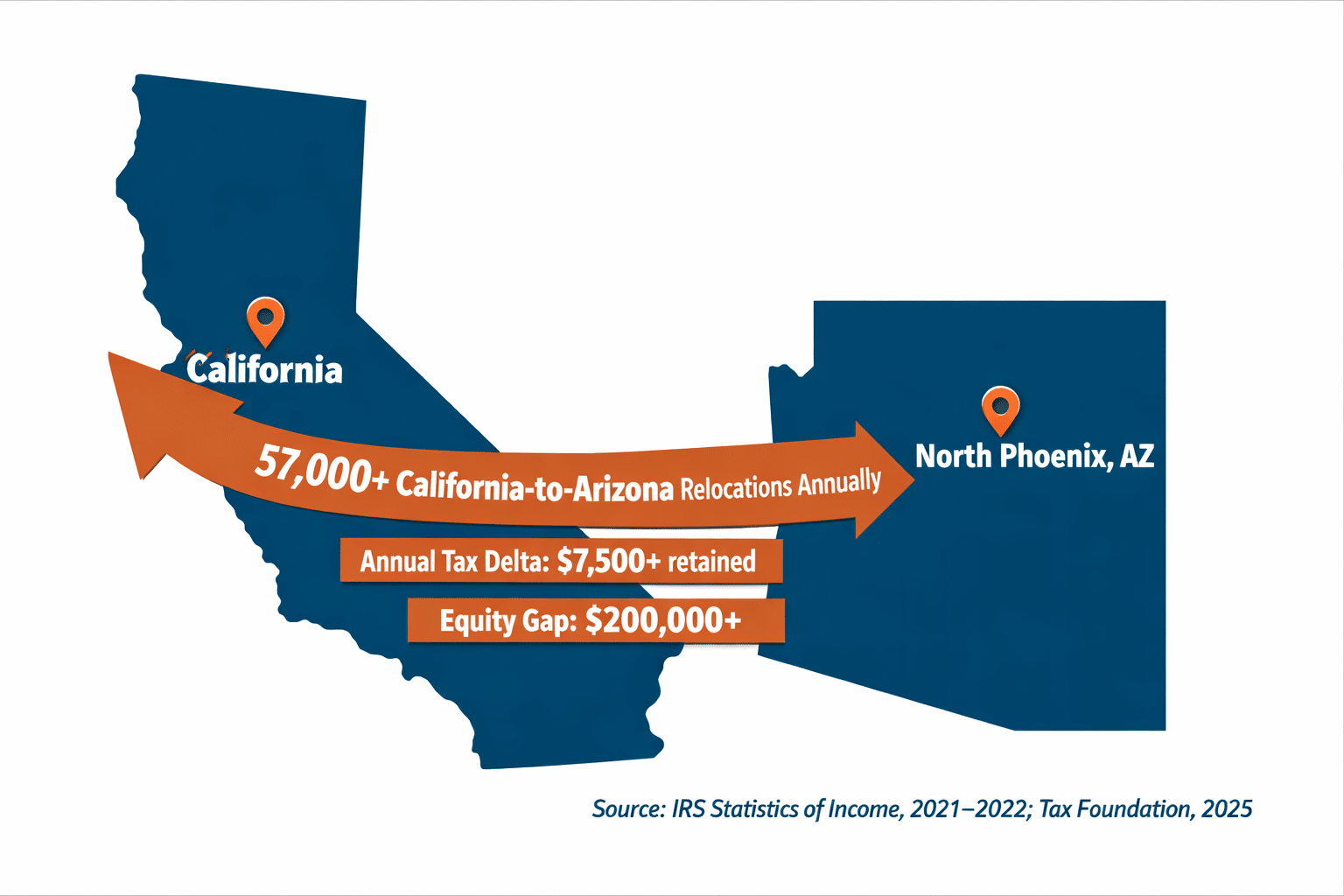
Arizona didn’t become a relocation hotspot by accident—and the 2023 Census migration data helps explain why. If you’re seeing headlines about the “California exodus,” the numbers behind it are more nuanced than the soundbites, but the trend line is clear: Arizona is still a net magnet for domestic movers, and California remains one of the biggest sources feeding that pipeline.
So what’s with “81,200 and counting”? Depending on which dataset (and which year) a report is referencing, that number is often used to describe Arizona’s net domestic migration gains in the early-2020s. For example, one Arizona-focused analysis using ACS-based microdata estimated Arizona’s net domestic migration gain at 81,612 in 2022—and while that eased in 2023, the state still posted a strong net gain.
Below is a buyer-and-seller-friendly breakdown of what the Census data is actually measuring, what it says about California out-migration, and what it means on the ground in the Phoenix metro.
First, What “2023 Census Migration Data” Actually Means
When people say “Census migration data,” they’re often referring to the American Community Survey (ACS)—an annual survey that asks (among many things) where someone lived one year ago. The Census Bureau then uses that to create state-to-state migration flow estimates (current state of residence crossed with state of residence one year ago).
A few key points that matter when you’re interpreting migration headlines:
- These are estimates, not headcounts. The ACS is sample-based and includes margins of error.
- “Flow” is not the same as “net.” A big California → Arizona flow can exist at the same time as a meaningful Arizona → California flow. Net is the difference.
- It’s a one-year lookback. The “2023” migration flow reflects moves where a person lived in one state a year earlier and a different state in 2023.
This is why two articles can both be “right” while using different numbers—some are citing net domestic migration, others are citing specific state-to-state flows, and others are using IRS tax return migration (a totally different lens).
The Big Picture: Arizona Stayed a Net In-Migration State in 2023
One of the cleanest high-level takeaways: Arizona remained one of the top states for net domestic migration in 2023.
An Arizona Economic and Business Research Center (EBRC) analysis of the 2023 ACS 1-year estimates reported:
- 256,203 people moved into Arizona from another state (domestic in-migration)
- Arizona’s net domestic migration was +62,533 in 2023 (more in than out)
That’s a little lower than earlier-pandemic peaks (hence the “slowing” narrative you may see), but it’s still a meaningful positive net for a single year.
The California Connection: What the 2023 Data Says About the “Exodus”
California’s out-migration story isn’t “everybody is leaving.” It’s “enough people are leaving—and enough high earners/remote workers are among them—that it shows up in the data year after year.”
A Common Sense Institute report summarizing 2023 ACS migration flows noted:
- 54,222 people moved from California to Arizona in 2023
- That flow was over one-fifth of all movers into Arizona that year
- After accounting for people who moved from Arizona to California, California represented over 53% of Arizona’s net domestic migration
That last point is the one many people miss: even if Arizona gets movers from all over, California can dominate the net gain because the flow in one direction is so large relative to the reverse.
And yes—California’s overall domestic picture was negative in 2023. The same report cited California losing over 268,000 residents via net domestic migration.
Why Arizona Keeps Winning the California Comparison
The data tells you what is happening. Housing decisions tell you why. In practice, California-to-Arizona movers tend to cluster around a few predictable motivators:
Housing buying power (even at “higher” Arizona price points)
Many relocators aren’t necessarily searching for the cheapest home—they’re searching for more home for the money (space, yard, garage, newer build, or a better school/commute balance).
That’s why browsing real inventory in the Phoenix real estate market is often eye-opening for out-of-state buyers, especially those comparing central convenience vs. suburban new-build options. If you’re just starting to benchmark neighborhoods, the Phoenix housing market and listings are a helpful baseline.
Lifestyle + climate trade-offs
Arizona summers are no joke. But for many households, the trade is worth it for:
- outdoor access in fall/winter/spring
- easier day-to-day driving and parking
- proximity to hiking, golf, and weekend getaways
Communities that package that lifestyle well—like Scottsdale homes and lifestyle communities—often end up on short lists for California buyers who want amenities and a “destination” feel.
Remote work reshaping “commute logic”
A big shift in the 2020s: not everyone is choosing a city based on a daily drive. When commuting becomes 2–3 days a week (or fully remote), buyers prioritize:
- home office setups
- newer floorplans
- quieter neighborhoods
- space for visiting family
That’s part of why the East Valley continues to pull attention from out-of-state move-ups and young families—especially in places like Gilbert neighborhoods with newer housing and fast-growing pockets of Queen Creek homes and new construction.
The “81,200” Context: Why the Number Still Matters
Even though 2023’s net domestic migration for Arizona is often cited around +62,533, earlier years (like 2022) show just how intense the inflow can get. One analysis using ACS microdata estimated Arizona’s 2022 net domestic migration gain at 81,612.
That “81,200 and counting” framing is useful because it illustrates a reality for Phoenix-area housing:
- Even when net migration cools from a peak year, the baseline can remain high.
- Those movers don’t distribute evenly. They concentrate in the Phoenix metro and a handful of suburban corridors.
- Housing supply doesn’t instantly expand just because demand is steady rather than exploding.
Translation: you may not feel a “boom” every year, but the ongoing inflow supports long-term housing demand.
What This Means for Phoenix-Area Home Buyers in 2026
If you’re relocating from California (or competing with people who are), the migration data has a few practical takeaways.
1) Be clear on your “must-haves” before you tour
Because Phoenix inventory spans everything from mid-century central Phoenix homes to brand-new master-planned builds, it’s easy to waste weekends touring homes that don’t match your lifestyle.
A simple shortlist helps:
- single-story vs. two-story
- pool now vs. pool later
- HOA comfort level
- commute radius (or airport radius)
- school priorities (if relevant)
2) Expect competitive pockets—especially for “California-friendly” floorplans
Even in calmer market periods, certain listings draw multiple offers because they match what many relocators want:
- 3-car garage
- flex room / office
- updated kitchens
- turnkey yards (pool, turf, patio)
- single-level living
3) Use local guidance early (not after you fall in love with a house)
Relocation buyers often underestimate how micro-local the Valley is. Two neighborhoods with the same ZIP code can feel totally different (HOA rules, commute patterns, remodeling norms, noise, or even short-term rental restrictions).
If you want a structured plan before you jump into tours, the Arizona home buying guide is a solid place to start.
What This Means for Phoenix-Area Sellers
Migration doesn’t guarantee you a bidding war—but it does shape who your buyers are and what they notice.
Highlight what relocation buyers value
- clear, clean listing photos (light + space)
- floorplan functionality (office, storage, garage)
- low-maintenance yards (or at least a well-presented outdoor space)
- receipts/notes on major system upgrades (roof, HVAC, windows)
Price like a local market, not a headline market
Even when demand is strong, buyers still compare your home to the three closest competitors. Overpricing is still the fastest way to invite longer days-on-market and price reductions.
Image Suggestions for This Post
- A simple map graphic: “Top origin states for Arizona movers (2023 ACS)”
- A bar chart: “Arizona net domestic migration (2022 vs 2023)”
- A Phoenix metro map showing the most common relocation target areas (Central Phoenix, Scottsdale, East Valley growth corridor)
FAQs
Is the “California exodus” real according to the Census?
Yes in the sense that California continues to show large outbound state-to-state flows and negative net domestic migration, while Arizona remains a net destination.
How many people moved from California to Arizona in 2023?
One summary of the 2023 ACS state-to-state migration flows estimated 54,222 people moved from California to Arizona in 2023.
Why do different articles give different migration numbers?
Because they may be using different sources (ACS vs. IRS tax returns), different definitions (net vs. flow), or different time windows (2022 vs. 2023). The Census migration flow tables are ACS-based and sample-driven.
Where do California relocators tend to buy in the Phoenix metro?
Many cluster in lifestyle hubs (like Scottsdale), central convenience areas (Phoenix), and newer suburban communities (East Valley). Exact patterns vary by job location, family needs, and budget.
Does net migration affect home prices immediately?
Not always immediately—but sustained net in-migration can support demand over time, especially if housing supply doesn’t expand at the same pace.
Bottom Line
The 2023 Census migration data doesn’t just tell a story about people leaving California—it shows how consistently Arizona (and the Phoenix metro in particular) remains a top landing spot. Whether you focus on peak-year net gains (the “81,200 and counting” context) or the latest year’s totals, the takeaway is the same: relocation demand is still a major force in Valley housing.
If you’re ready to translate these trends into a real move, connect with West USA Realty and start scouting live inventory through Arizona homes for sale.