
King County’s median single-family home price was $974,900 for full-year 2025, according to the Northwest Multiple Listing Service 2025 Annual Report. The Greater Phoenix median sale price is $450,000. That $524,900 gap does not disappear when you sell — it converts into deployable equity. This guide shows you exactly where it lands in the Phoenix Valley, what the complete transaction cost picture looks like on the Washington side, and how the tax math works for a household relocating from a no-income-tax state.
King County homeowners relocating to Arizona are not compressing their financial position — they are restructuring it. The arithmetic is direct. Sell a 2025 median-priced single-family home in King County for $974,900. Subtract Washington’s Real Estate Excise Tax (approximately $11,700 on a sale at this price, calculated on the state’s graduated REET schedule), combined agent commissions of approximately $58,494 (at 6%), and standard pre-sale costs. Net proceeds land in a range of approximately $890,000 to $905,000.
Purchase a comparable or larger home in the Greater Phoenix area at the ARMLS median of $450,000. Subtract standard Arizona closing costs of approximately $4,000 to $6,000. The result: a King County seller at the 2025 annual median can acquire a Phoenix Valley home outright — no mortgage — and retain between $435,000 and $455,000 in liquid equity.
That retained equity can eliminate a housing payment entirely, fund a renovation, build a reserve account, or be deployed into investment assets. The annual yield on $440,000 at a conservative 4% return produces $17,600 per year — a figure that substantially exceeds the income tax differential this move introduces for most households (Arizona’s 2.5% flat rate applied to income that was previously untaxed at the state level in Washington).
The equity math is the starting point, but it is not the whole picture. A complete King County-to-Arizona financial model must account for: the REET on the Washington sale, the income tax introduction (Arizona charges 2.5%, which Washington does not), the annual property tax reduction on the new lower-priced Arizona asset, the sales tax decrease, and the monthly mortgage payment reduction for households that choose to carry any debt at all on the Arizona property. Each of those variables is addressed in turn in this guide.
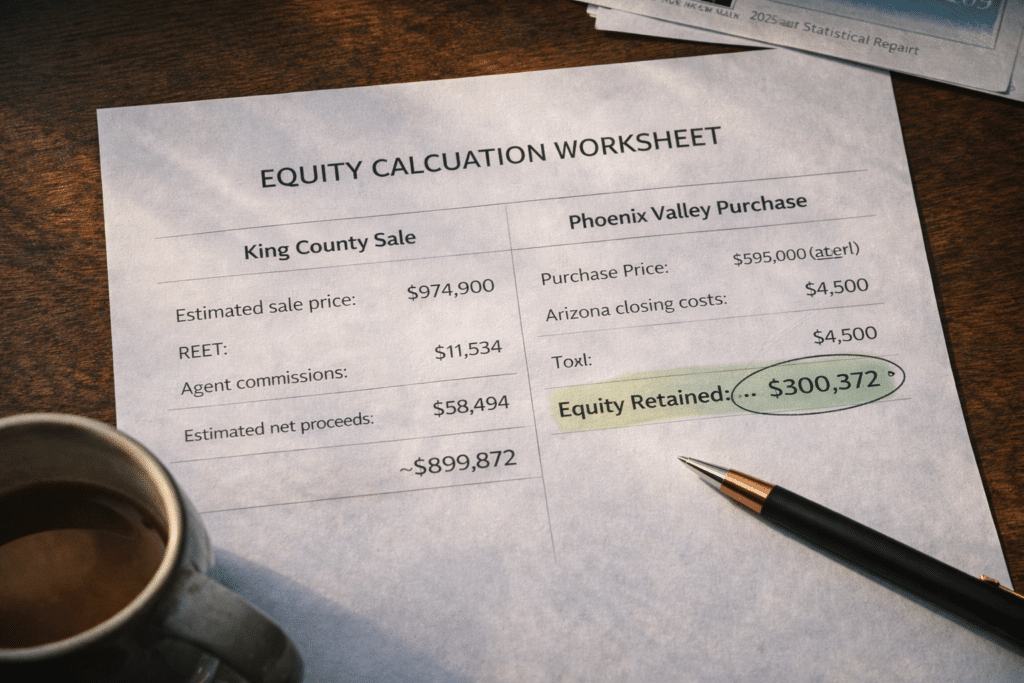
A King County seller at the 2025 NWMLS median of $974,900 carries estimated net proceeds of approximately $895,000 to $905,000 after Washington’s REET, combined agent commissions, and pre-sale preparation costs. The table below maps those proceeds against the six primary destination communities for King County-origin buyers, assuming standard Arizona closing costs on the destination purchase.
Note on Scottsdale: The only Valley destination where King County-median net proceeds fall short of a no-mortgage purchase is Scottsdale, where the 2025 YTD median of approximately $1,180,000 requires either additional capital or a moderate mortgage on the Arizona side. For King County sellers above the median — Bellevue, Kirkland, Mercer Island — Scottsdale transactions are frequently achievable with retained equity remaining.
The pattern across five of six destinations is consistent: a King County seller at or near the 2025 annual median can acquire a Phoenix Valley home outright and retain a six-figure cash balance. This is qualitatively different from the California-origin story, where retained equity exists but a mortgage often remains. For King County sellers, the option of a zero-mortgage Arizona purchase is real and numerically supported at the median level.

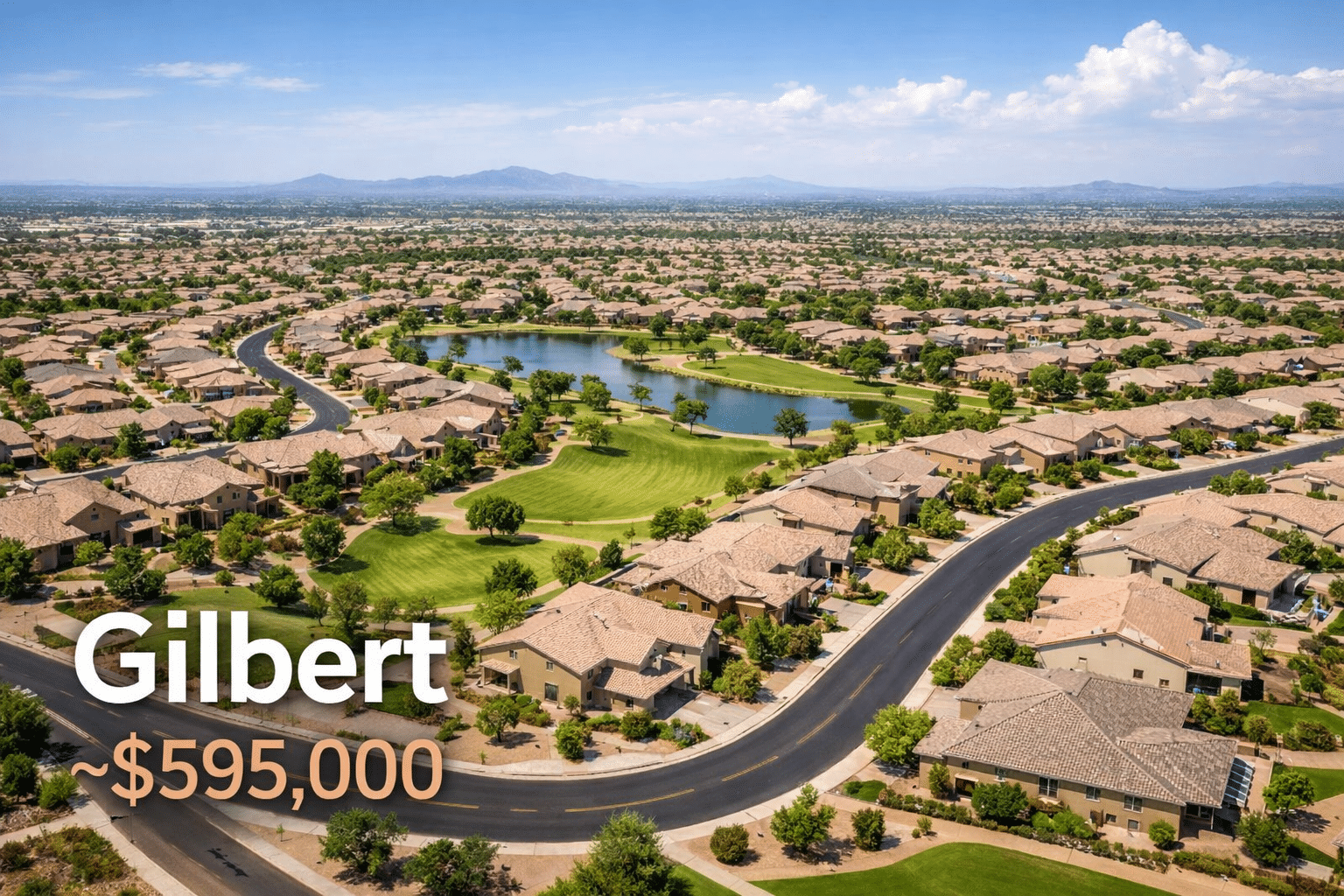
Est. Equity Retained: ~$295K–$310K
Master-planned communities, HOA infrastructure, large lot inventory
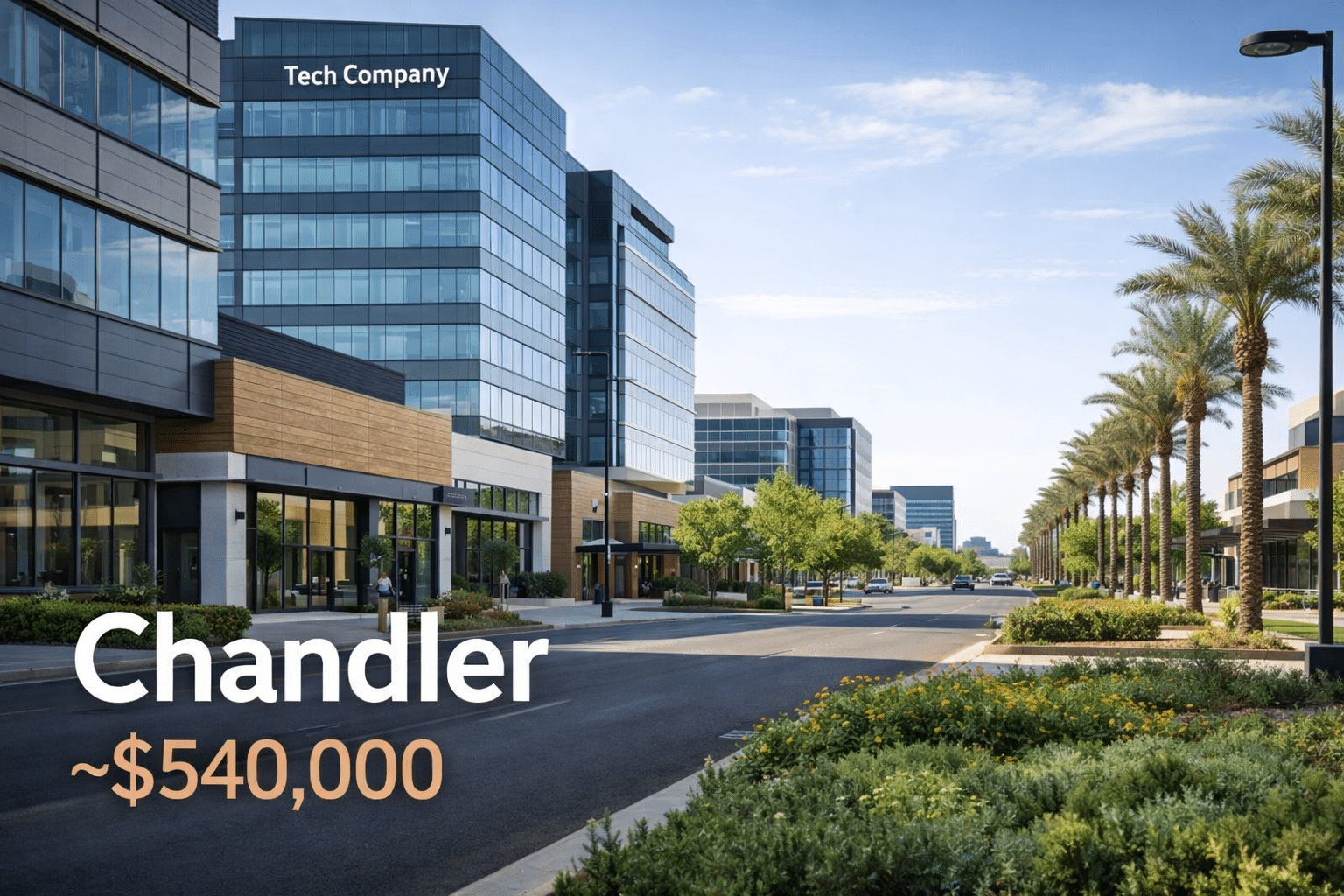
Est. Equity Retained: ~$350K–$365K
Tech corridor proximity, broad resale and new-build inventory

Est. Equity Retained: ~($280K–$290K)
Premium positioning; (at Scottsdale shortfall vs. net move-up from the median) proceeds — requires median requires additional capital additional capital
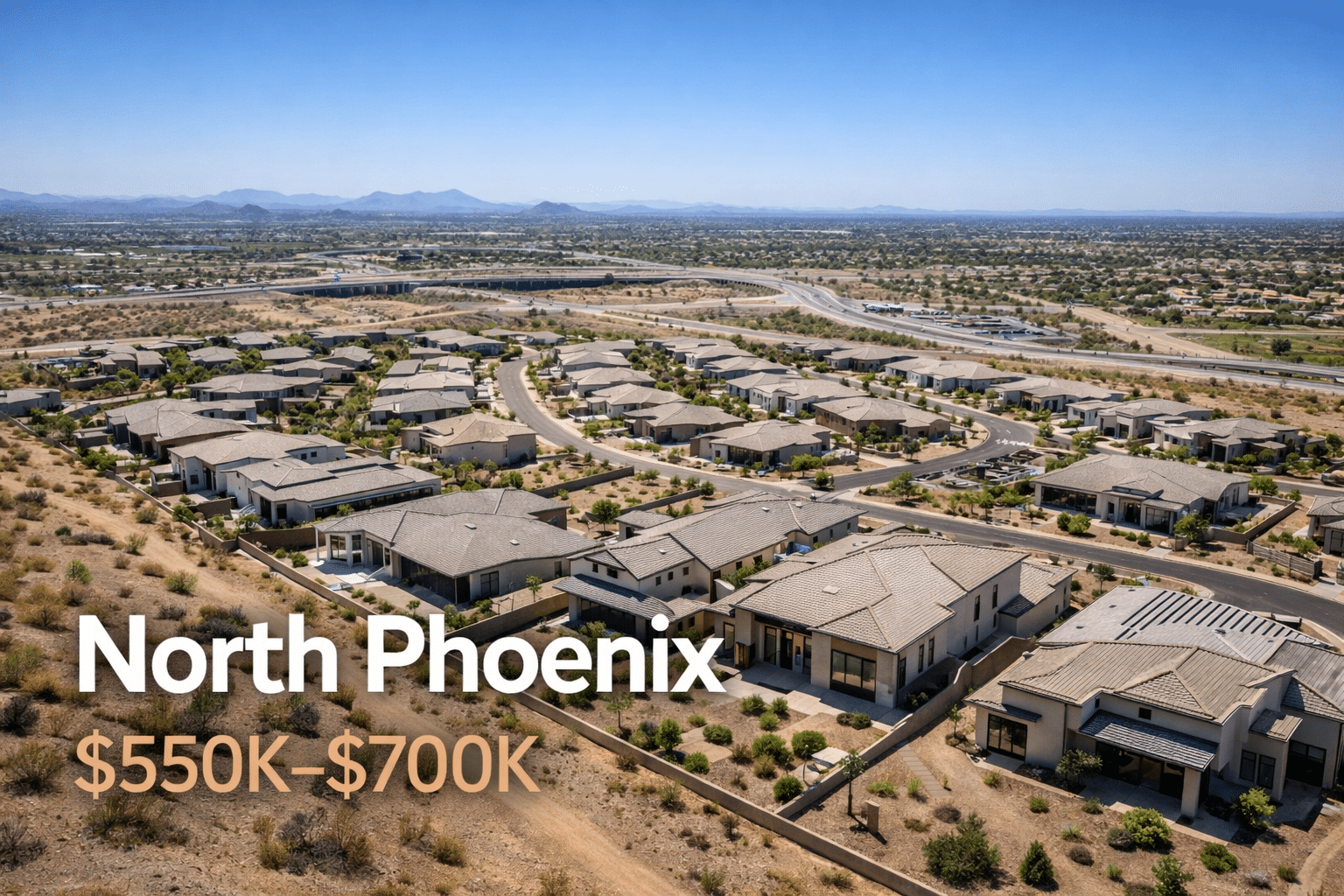
Est. Equity Retained: ~$195K–$355K
Newer master-planned Desert Ridge builds, Loop 101 and Loop 51 access
Est. Equity Retained: ~$465K–$475K
Maximum square Goodyear footage per dollar, rapid new build-out
Price data: ARMLS, Phoenix REALTORS year-to-date 2025 reports. Net equity estimates assume REET of ~$11,700, 6% combined agent commissions on the King County sale, and $4,500 in Arizona closing costs.
The most important disclaimer for any Washington-origin household considering Arizona: this move introduces a state income tax that does not currently exist. Washington has no state income tax. Arizona charges a flat 2.5% on all taxable income. For a dual-income household earning $220,000, that introduction costs approximately $5,500 per year in new state tax liability. Model it in as a real annual cost. Do not rationalize it away.
With that acknowledged, the complete picture includes multiple categories where Arizona produces material annual savings:
Running the annual numbers on a household purchasing at $595,000 in Gilbert and earning $220,000 combined:
Annual income tax increase (AZ 2.5% on $220K): +$5,500/year (new cost) Annual property tax savings ($974,900 → $595,000 asset): -$7,580/year (savings) Net property basis savings (old WA at 0.92% on assessed $8,969 WA vs. $3,094 value vs. new AZ at 0.52% on $595K): AZ = $5,875/year Annual sales tax savings (10.5% → 8.4% on $60K spend): -$1,260/year (savings)
Net annual fiscal position change (excluding REET and equity deployment): approximately +$1,635 per year favorable to Arizona, before accounting for the one-time equity redeployment gain.
The annual operating delta is meaningful but modest. The larger financial event is the equity redeployment — a one-time structural shift that produces compounding returns over time. A household that retains $440,000 in liquid capital after a zero-mortgage Arizona purchase and deploys that capital at 4% annually earns $17,600 per year in passive income — a return that dwarfs both the income tax introduction and the annual fiscal savings combined.
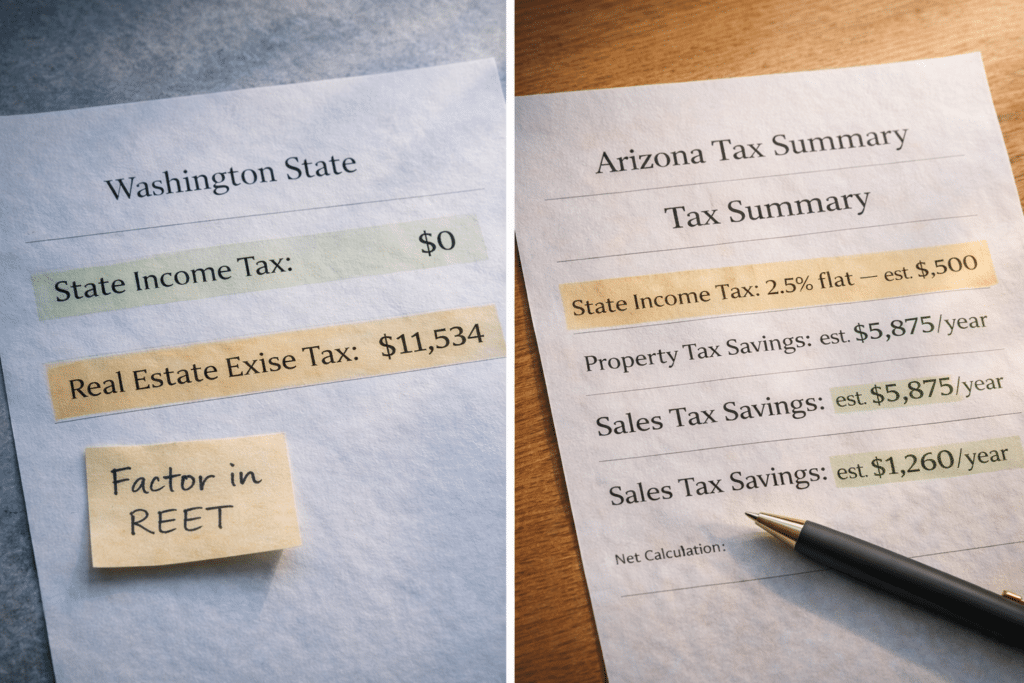
Estimated net annual fiscal improvement for a King County-to-Gilbert household earning $220,000 combined, after factoring in the income tax introduction and property + sales tax reductions
Source: Calculation based on Tax Foundation 2025, NWMLS 2025 Annual Report, ARMLS November 2025, Maricopa County Treasurer, Washington Dept. of Revenue
| Tax Category | WA (King County) | AZ (Maricopa County) |
|---|---|---|
| State Income Tax | 0% — no state income tax |
2.5% flat rate ⚠ Introduces new cost |
| Effective Property Tax Rate | ~0.92% |
~0.52% ✓ Annual savings |
| Avg Combined Sales Tax | ~10.5% (Seattle / King County area) |
~8.4% ✓ Annual savings |
| Real Estate Excise Tax (seller) | Yes — graduated; ~1.1–1.28% of sale price |
None at state level ✓ One-time exit cost avoided on Arizona purchases |
| Capital Gains Tax (investment assets) |
7% on gains above $278K (2025 deduction); 9.9% above $1M. Real estate sales exempt. |
None ✓ Eliminates for investment portfolio holders |
| Estate Tax | Yes — applies to estates over $2.193M; 10–20% graduated rates |
None ✓ Relevant for higher-net-worth households |
Sources: Tax Foundation 2025 State Tax Rates; Washington Dept. of Revenue; Maricopa County Treasurer; Washington State Dept. of Revenue REET Schedule
Washington’s Real Estate Excise Tax is a seller-paid transaction tax that most homeowners dramatically underestimate until they review their closing disclosure. It is not a commission, not a capital gains tax, and not optional. It is a statutory excise tax applied at the state level — and often supplemented by county or city local REET on top — on every real property sale in the state.
Washington’s REET is calculated on a graduated schedule based on the sale price:
| Sale Price Range | REET Rate |
|---|---|
| $0 – $525,000 | 1.10% |
| $525,000 – $1,525,000 | 1.28% |
| $1,525,000 – $3,025,000 | 2.75% |
| Over $3,025,000 | 3.00% |
Source: Washington State Dept. of Revenue, REET Rate Schedule
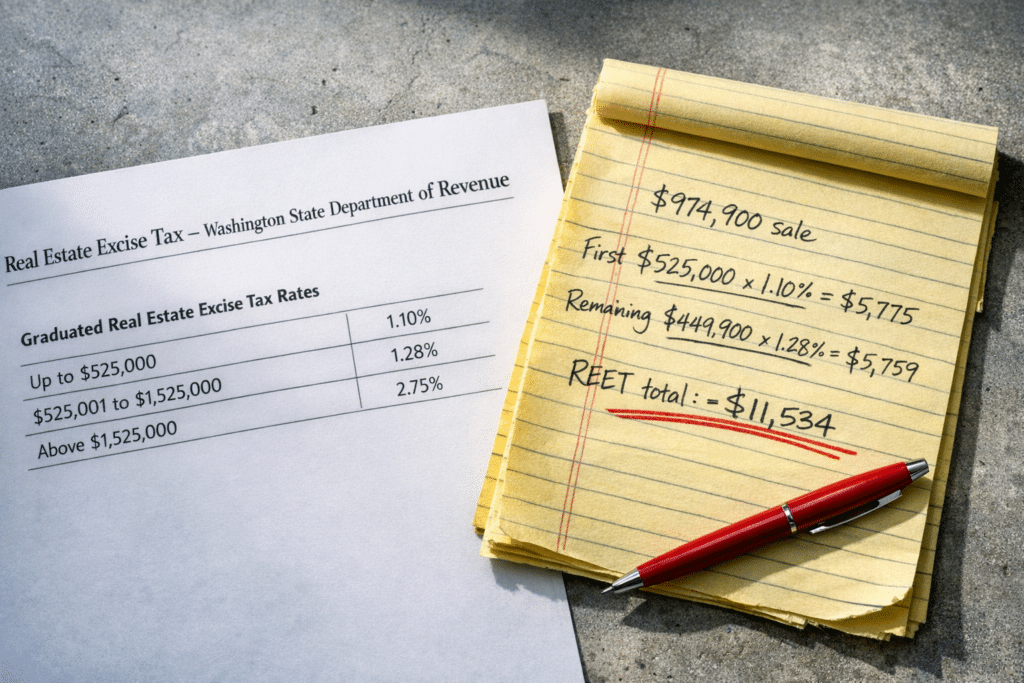
Estimated REET on a King County home selling at the 2025 NWMLS annual median ($974,900), based on Washington’s graduated REET schedule
The REET is factored into all equity retention estimates on this page. It is a real exit cost embedded in Washington homeownership — and one of the variables that makes precision modeling essential before making an offer on an Arizona property.
Source: Washington State Department of Revenue REET Rate Table
For a King County single-family home selling at the 2025 annual median of $974,900, the approximate REET calculation is:
First $525,000 at 1.10% = $5,775 Remaining $449,900 at 1.28% = $5,759 Total estimated REET: $11,534
This is a transaction cost that does not exist in Arizona. When King County sellers compare gross sale prices to Phoenix Valley list prices without accounting for the REET, they systematically overestimate their net proceeds by approximately $11,000 to $12,000. At a $1.2M sale price — common in Bellevue, Kirkland, or Mercer Island — the REET liability approaches $15,000 before any local supplemental REET is added.
The Bureau of Labor Statistics Consumer Price Index for the Seattle-Tacoma- Bellevue metropolitan area has tracked consistently 10% to 15% above the national average across recent annual measurement periods. The Phoenix metro runs approximately 3% to 6% above the national average — a significant spread that is felt most acutely in housing but extends across transportation, insurance, and day-to-day expenditures.
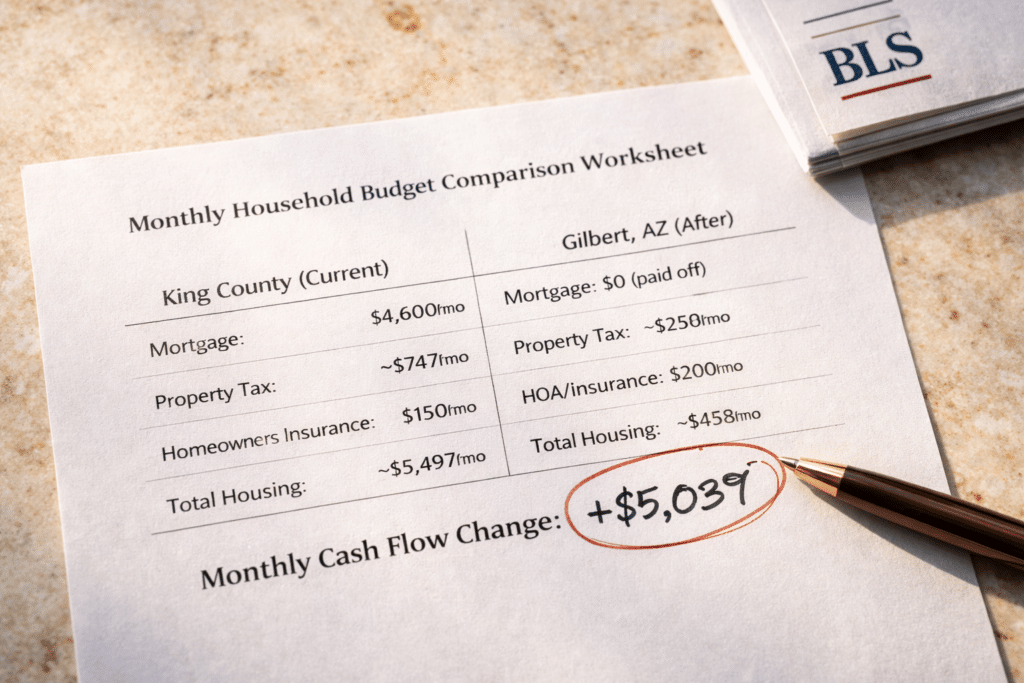
The monthly housing cost differential is the largest single variable. A King County homeowner currently carrying a $4,600 per month mortgage payment on a median-priced $974,900 home (approximate payment with 20% down at 6.5%) who purchases a $595,000 home in Gilbert with no mortgage carries zero monthly housing payment. That is a cash flow event of $4,600 per month — $55,200 per year — that can be redirected entirely to savings, investment, or retirement funding. Even for households that choose to carry a modest mortgage on the Arizona property, the payment reduction runs approximately $2,500 to $3,800 per month compared to the King County baseline.
Washington’s combined state-and-local sales tax in the King County corridor runs approximately 10.5%. Arizona’s statewide average combined sales tax is 8.4%, per the Tax Foundation. On $60,000 in annual taxable expenditures, the 2.1-percentage-point reduction produces approximately $1,260 per year in additional purchasing power — persistent and compounding over time.
One cost category where the Phoenix metro is not cheaper: summer cooling. Expect electric bills of $250 to $400 per month from June through September in a typical single-family home. Model this against Seattle’s relatively modest utility costs. But also model in that you are no longer paying King County’s rising property tax assessments on a home valued near $975,000 — assessments that will continue to grow as the county revalues annually.
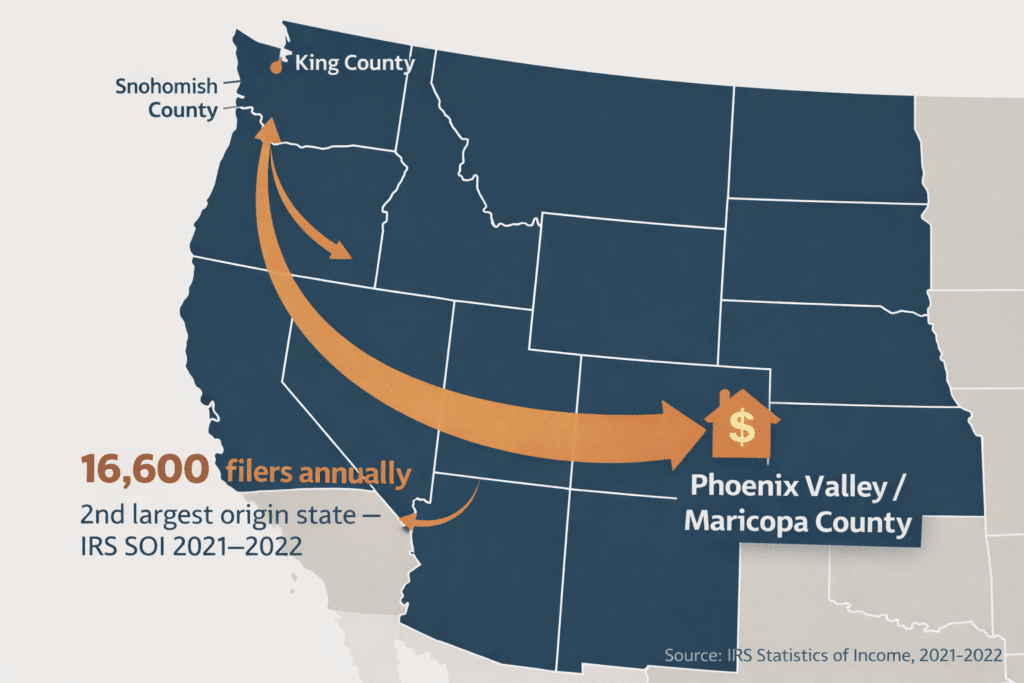
King County is the primary source of Washington’s Arizona-bound migration. According to IRS Statistics of Income data for the 2021–2022 filing year, Washington state as a whole sent 16,600 tax filers to Arizona — the second- largest origin state in the nation behind California. King County accounts for the largest share of that flow, as the state’s most populous county and its highest-price housing market.
The income profile of this migration contains a critical signal. According to Tax Foundation analysis of IRS Statistics of Income data, Washington state experienced a net gain in total tax return filers through domestic migration in 2021–2022, while simultaneously recording a net loss in aggregate adjusted gross income from those same filers. The interpretation is clear: Washington was gaining new residents at lower average income levels while losing residents with above-average incomes. The households leaving King County for Arizona are not a cross-section of the county’s income distribution. They are weighted toward the higher-income, higher-equity cohort — households with a meaningful asset position and the financial profile to act on it.
King County is also a documented top-ten source county for Maricopa County in-migration, appearing in IRS county-to-county data as one of the highest- volume non-California origin counties for Arizona-bound households. The Seattle-to-Phoenix corridor is established, structurally supported by equity economics, and accelerating as King County prices outpace income growth.
AZ Economy source data — IRS county-level citation: King County listed as a top-ten external source for Maricopa County in-migrants. Source: Arizona’s Economy research analysis of IRS Statistics of Income County-to-County Migration Data, 2021–2022
The Phoenix Valley is not a uniform market. Each destination community has a distinct price point, inventory profile, and financial characteristic relevant to King County-origin buyers making a large equity decision.
Gilbert's 2025 YTD median of approximately $595,000 positions it as the value inflection point in this guide's equity table: a King County seller at the annual median arrives with $295,000 to $310,000 in retained equity after a zero-mortgage purchase. Gilbert's master-planned inventory offers HOA- maintained amenities — pools, parks, trail systems, and common area maintenance — as documented community infrastructure. The build-out is largely established, reducing new construction risk for buyers who prefer a stable grid.
Chandler's median of approximately $540,000 produces the highest retained equity of any significant Valley market outside the West Valley: $350,000 to $365,000 in cash after an all-cash purchase at the median. The community sits adjacent to the Loop 202 technology employment corridor, offering proximity to multiple large corporate campuses for households with dual-income considerations. Resale inventory is deeper here than in some master-planned communities, creating more negotiating leverage on the Arizona side of the transaction.
Scottsdale's 2025 YTD median of approximately $1,180,000 is the single Valley destination where King County-median net proceeds fall short of a zero-mortgage purchase. Buyers in this corridor are typically King County sellers above the median — Bellevue, Kirkland, Mercer Island — where net proceeds can reach $1.1M to $1.3M. North Scottsdale's luxury inventory competes on square footage and lot size with Eastside King County properties in ways that other Valley communities cannot match.
The North Phoenix and Desert Ridge corridor ($550,000 to $700,000) offers the largest concentration of recently completed and actively developing master-planned inventory in the Valley. For King County buyers who prefer new construction warranties and contemporary floor plans over established resale stock, this corridor provides substantial options within the equity retention range documented in Section 4.
Mesa's approximately $490,000 median produces $405,000 to $415,000 in retained equity for King County sellers at the 2025 annual median — the largest retained balance of any established-grid community in this guide's table. Mesa's inventory spans a wider price and vintage range than any other destination, from entry-level resale to large-lot custom construction, giving buyers flexibility that tighter markets cannot provide.
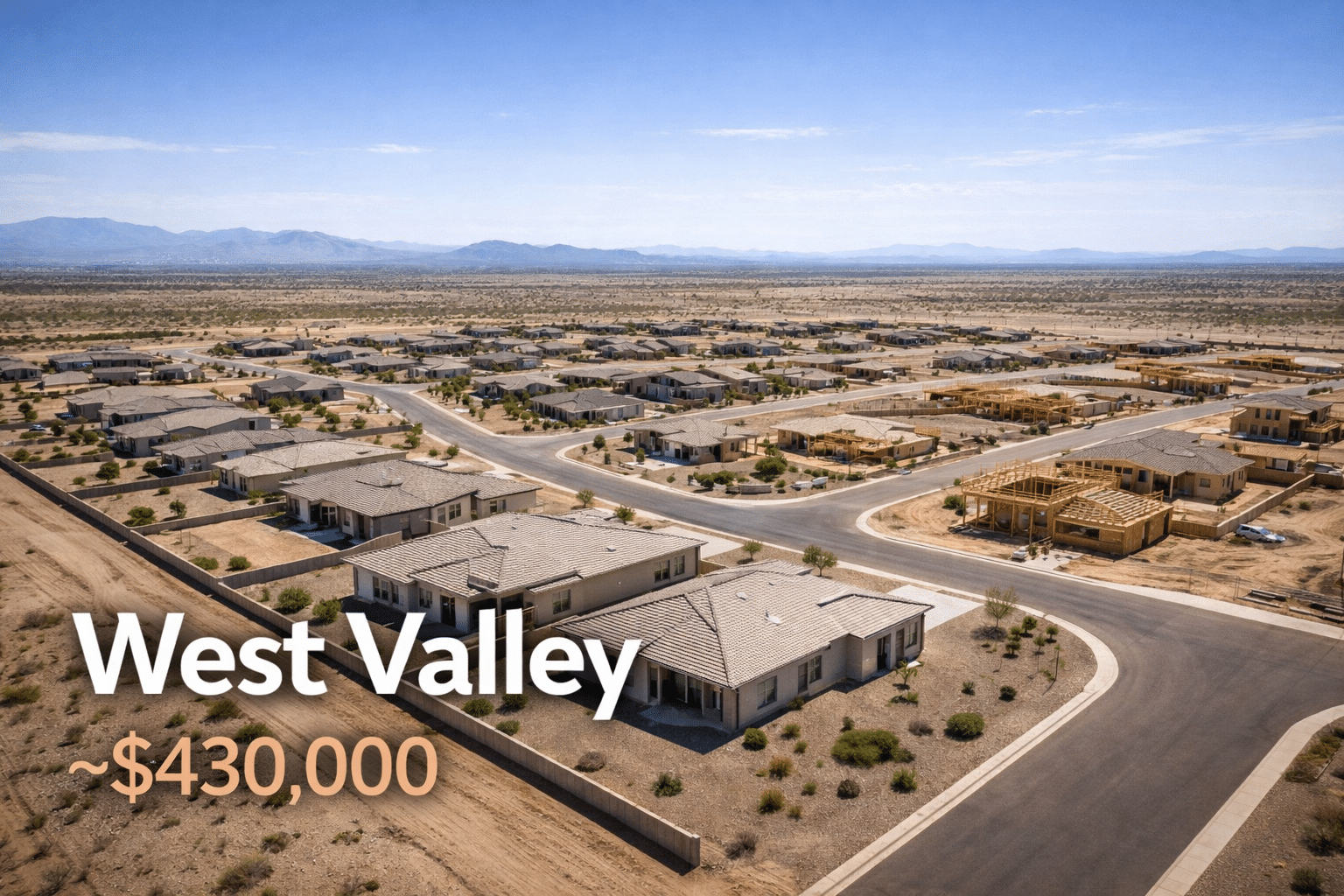
At approximately $430,000, Surprise and Goodyear represent the furthest equity extension available in the Valley. A King County seller at the annual median purchases here with approximately $465,000 to $475,000 in retained equity after a zero-mortgage acquisition. The West Valley's active construction pipeline means inventory is newer, build-out is ongoing, and lot sizes are larger per dollar than the East Valley. The trade-off is distance from the Phoenix core.